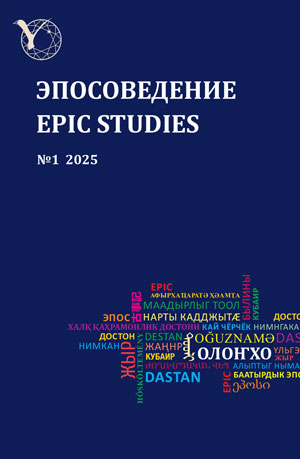
The journal "Eposovedenie" was founded in 2016 as a series of the "Vestnik of NEFU" at the M.K. Ammosov North-Eastern Federal University (Yakutsk, Republic of Sakha (Yakutia). Since 2021, it has become an independent scientific publication. The journal is based on a narrow direction in folklore studies - epic studies. The purpose of the publication is to highlight new results of scientific activity of the Russian and foreign scientific community in the field of modern epic studies and other genres of folklore; promote the development of theoretical and applied research in the field of social and humanitarian knowledge; establish and strengthen scientific ties between scientists from different regions of Russia and other countries in the field of folklore studies, linguistics - current issues and various aspects of the language of the epic. The journal accepts articles in the direction (according to the nomenclature of the Higher Attestation Commission) 5.9. Philology: 5.9.4. Folklore studies, and 5.9.5. Russian language. Languages of the peoples of Russia. Since 2024, the journal has been indexed in the international database Scopus (Q1 - Cultural studies, Q2 - Anthropology and Linguistics and Language).
Current issue
Articles
The study examines archaic layers of epic consciousness through the prism of the tree image functioning as a weapon, a test of heroic strength, and a cosmological symbol. The novelty of the research lies in presenting the first systematic comparative analysis of the motif of uprooting trees across three distinct epic traditions: the Yakut olonkho, East Slavic bylins, and the Armenian heroic epic Sasna Tsrer (David of Sassoun, Daredevils of Sassoun). The tree is analyzed not merely as an element of landscape description, but as a semantically charged object connecting the hero with the mythological vertical structure of the world.
The article aims to identify typological similarities and functional differences in the use of the tree motif within various epic systems. To achieve this goal, the study analyzes motifs of uprooting trees, their use in combat, in initiatory situations, and in cosmological acts associated with the transformation and purification of space.
The research employs a comparative-typological method, allowing the identification of universal patterns in the development of epic traditions. A semiotic approach is applied to the analysis of the heroes’ material world and the symbolic functions of the tree, while the historical-genetic method facilitates the reconstruction of archaic mythopoetic layers reflecting the transition from “natural” to culturally forged weapons.
The selection of the Yakut olonkho, Russian bylins, and the Armenian epic is determined by the fact that these traditions represent different levels of preservation of archaic epic consciousness and different functional realizations of the tree motif – from cosmological and ritual forms to heroic-combat and locally practical ones. Their comparison makes it possible to trace the typological evolution of the motif within a broad Eurasian context.
The study demonstrates that in olonkho the tree (spruce, birch) preserves the most archaic cosmological significance and is connected with the idea of the World Tree, spatial transformation, and the restoration of cosmic balance. In Russian bylins, the uprooted oak primarily symbolizes the excessive physical power of the bogatyr, while still retaining traces of archaic mythological semantics associated with the World Tree. In the Armenian epic, the tree (poplar, plane tree, aspen) functions mainly as a natural substitute for conventional weapons and reflects the historicization of epic consciousness and its connection with everyday material culture.
The comparative analysis reveals a general typological transformation of the motif: from a cosmologically meaningful act associated with mythological conceptions of the universe toward its gradual functional reduction and reinterpretation within heroic-epic narrative structures. The article concludes that the use of the tree in epic traditions represents not only a formula of heroic hyperbole, but also a transformed relic of ancient mythological notions concerning cosmic order and the hero’s place within it.
This article presents a comprehensive study of some names of Buddhist utensils in the Mongolian (Khalkha-Mongolian, Buryat, and Kalmyk) languages. The study of Buddhist vocabulary in Mongolian languages is relevant for understanding both the history of the spread of Buddhism and the development of the vocabulary of these languages. The names of Buddhist utensils are an interesting object for comparative study of the vocabulary of Mongolian languages. The novelty of this work lies in the fact that the authors, for the first time, identify and analyze the names of Buddhist utensils based on an extensive corpus of sources. These include bilingual and trilingual dictionaries, the Kalmyk heroic epic “Dzhangar”, various folklore texts of Mongolian peoples: fairy tales, riddles, proverbs and sayings, as well as ancient written monuments (such as the Rig Veda and Arshani nomin tuuji (“The Tale of the Nectar Teaching”)). The authors’ personal fieldwork (2010; 2025) collected in Kalmykia, Buryatia, and Mongolia served as an additional source for interpreting Buddhist terms. The aim of this article is to identify, systematize, and comprehensively study the names of Buddhist utensils in Mongolian languages (Khalkha-Mongolian, Buryat, and Kalmyk), taking into account their use in folklore texts. A comprehensive approach was employed in the study. A continuous sampling method was used for the systematic collection of lexical material. The identified lexical units were characterized using a descriptive method. Comparativetypological and comparative-contrastive methods made it possible to establish common and specific features in the vocabulary of Buddhist utensils in Mongolian languages. As a result, it was possible to identify both standardized and dialect-specific names. The authors conclude that the materials examined represent a valuable resource for studying the Buddhist vocabulary of Mongolian-speaking peoples. Information extracted from folklore texts significantly enriches and expands existing understanding of this lexical group. It has been established that the basis of the vocabulary under study is a common Mongolian lexical base, including early borrowings, particularly from Sanskrit. These borrowings passed through the Old Uyghur and Tibetan languages, undergoing preliminary phonomorphological assimilation and adaptation in accordance with the graphic and orthographic norms of the host languages. Prospects for further research include introducing the names of Buddhist utensils into scholarly circulation, which will expand our understanding of the Buddhist vocabulary of Mongolian languages. This, in turn, will serve as an additional source for a new understanding of this vocabulary and will facilitate more indepth comparative studies of Mongolian languages.
The article examines the variability and provides a comparative-historical analysis of the lexeme chechen (sesen, tsetsen, sheshen), attested in many Turkic and Mongolic languages of the peoples of Eurasia. The relevance of the study lies in the need for an in-depth investigation of linguistic and cultural convergence processes in the Turkic-Mongolic area, as well as in the insufficient development of comparative-historical and linguocultural analysis of this lexeme in contemporary scholarship. The aim of the study is to identify the historical, everyday, sacral, and linguocultural features of this lexeme through a comparison of its phonetic forms and semantic meanings in Altaic languages.
The novelty of the research lies in the comprehensive analysis of the lexeme chechen based on extensive material from Turkic and Mongolic languages, including lexicographic, folklore, and ethnographic sources, as well as in revealing the relationship between its phonetic variants and its sacral-semantic meanings within the cultural traditions of the peoples of Eurasia.
The methodological framework of the study is based on comparative-historical, typological, and linguocultural methods, as well as elements of etymological and semantic analysis. The material includes lexicographic sources, folklore texts, and ethnographic data of Turkic-Mongolic peoples (Altaians, Tuvans, Teleuts, Kazakhs, Kyrgyz, Bashkirs, Uyghurs, Sakha (Yakuts), Mongols, and Buryats).
The results of the study demonstrate that the lexeme chechen and its phonetic variants share a common semantic core associated with the concept of a special individual endowed with sacral qualities and performing the function of a spiritual mediator. Regular patterns of phonetic variation and semantic differentiation of the term have been identified depending on historical and ethnographic conditions, economic activities, and worldview systems of different peoples.
It is concluded that the lexeme chechen originally had a generalized meaning of “a bearer of a special gift connected with higher powers,” which, in the course of historical development, acquired various functional and cultural nuances. The results obtained contribute to a more precise understanding of cultural contacts, migration processes, and mechanisms of spiritual convergence in the Turkic-Mongolic world.
The article continues a series of studies on the character code of Karelian weddings and figurative nominations in folklore texts for family-related rituals. The focus here is on the images of the parents: the bride’s and the groom’s father and mother. We examine their role in ritual acts and point out the main naming types, which reflect the mechanisms through which family relationships function in the wedding ritual context. The aim is to determine the figurative nominations that help actualize the parents/father/mother concepts. The following tasks were fulfilled in the process: case-studying the corpus of Karelian wedding lyrics, the set of lexemes, poetic formulas explicating the parent (father and mother) characters was scrutinized, revealing the features common to all and specific to each concept. The study was based on the descriptive method, using also contextual and ethnolinguistic analysis. The dataset was the wedding lyrics corpus comprising published and archival texts of joik songs, laments, as well as epic runo songs integrated in the wedding ritual and constituting the wedding runo song series. Variants originating from all over the territory populated by Karelians were used in the analysis. Additional sources included dialect dictionaries and paroemiological data. From the linguoculturology perspective, this research on parent (father and mother) nominations contributes to advancing the Karelian folklore studies. The analysis revealed that the roles and functions of parents in the wedding ritual have undergone change: the position of the mother, who used to play the key role in the family relationships, has been taken over by the father – the man, the house master. The texts under study have preserved a uniform nomination system for these characters. The symbolization of the father and the mother aligns with the archetypal ideas established in the folk mind. Differences in the nominations are connected with the change of the bride’s and groom’s social statuses. Research on wedding lyrics, first of all Karelian wedding runo songs, will be continued by exploring sacral characters in weddings.
This article is devoted to the characterization of cultural codes in the texts of the shamanic ritual to the deity Ulgen among the Altai and Teleut peoples. The aim of the study is to determine the semantics of the cultural codes in these ritual texts. The research material is based on two texts of shamanic rituals of the Altai and Teleut peoples, recorded in the late 19th and early 20th centuries. The study utilized structural-semiotic and lexical-semantic methods of text analysis, as well as a methodology for describing linguocultural codes. The novelty of the study lies in the identification of linguocultural codes that model a complex of collective shamanic understandings of the world order.
As a result of the research, the author came to the following conclusions: the shamanic text and ritual are secondary sign systems in which the set of symbolic images that comprise the ethnoculture serves as the plane of expression. Cultural codes perform an accumulative function: they store the accumulated experience of knowing the world and the system of value orientations of shamanic culture. In these texts, each code is conditioned by the particular religious worldview of the shamans. The spatial code embodies the idea of a lack of boundaries between the real earthly and the otherworldly, celestial worlds, between which contact is established mentally. Toponyms mentioned in the text, denoting the dwelling places of the shaman’s spirit helpers, outline the sacred space of the ritual. The object code is objectified by the symbolic meanings imbued in ritual objects. The character code is determined by the role functions performed by the participants in the ritual: the shaman, his assistant, and the spectators. The various sounds emitted by the shaman, imitating the sounds of a goose or horse on which he sets out on his journey, demonstrate the playful nature of the ritual. The symbolism of the ritual actions of the shaman and his assistant, expressed in their actions, allows us to distinguish the actional and sound codes. The theonymic code consists of the personification of cosmic phenomena. The category of deities includes cosmic objects, as well as ancestral spirits who once enjoyed high social status. The spiritual values for which these rituals were performed define the axiological code. The color code reflects the shamanic perception and evaluation of spatial objects. The semantics of order and quantity are expressed by numerical symbols.
Magnanimity and nobility represent a fundamental moral quality that defines human conduct in accordance with humanistic values. This quality encompasses virtues such as self-sacrifice, loyalty, courage, mercy, and generosity. Throughout history, the concept of nobility has carried different meanings across various epochs. This article presents the first typological examination of magnanimity in European epics, including Homer’s “Iliad”, “The Song of the Cid”, “The Song of the Nibelungs” etc. Departing from traditional motifs such as conflict with monsters or enemies, father-son duels, and generational strife, the study highlights magnanimity as a previously underexplored yet essential characteristic of the epic hero. This theme is prominently featured both in the “Iliad”and in the Armenian epic. The analysis focuses on original texts and different recorded versions of the “Sasna Tsrer”. The theme of magnanimity in “Sasna Tsrer” has not previously received separate scholarly attention. In this article, it occupies a central position, as it organically emerges from the epic’s content. Notably, the hero’s magnanimity consistently appears after his heroic deeds.
The study argues that the ultimate goal of the epic hero is not merely martial valour but forgiveness and nobility, which elevate him above ordinary warriors. Similarly, Homer’s “Iliad” culminates in Achilles’ magnanimity overcoming his wrath, affirming empathy and humanity as the highest ideals. Although the theme of forgiveness is closely linked to Christian ideology and has profoundly shaped the epic, it must be acknowledged that magnanimity and mercy constitute organic elements of Armenian national psychology.This is confirmed in Armenian historiography and in the works of prominent European historians.
This interdisciplinary study, employing comparative, psychological, mythological, and synthetic methods, opens new perspectives in epic studies. It shifts the focus from purely heroic narratives toward the profound humanistic significance of magnanimity, clemency, and empathy, deepening our understanding of epics as expressions of national psychology and universal human values.
The article examines the image of the bird ular (Altai snowcock, Tetraogallus altaicus) in the traditional everyday culture of Tuvans and Western Mongolian peoples (including ethnic Tuvans of Mongolia). For the first time, oral narratives, mythological plots, and folk beliefs associated with this bird and preserved in oral tradition among both the Tuvans of the Republic of Tuva and Mongolian peoples are introduced into scholarly circulation.
The study is based on academic and popular scientific literature, the authors’ field notes collected during expeditions to the Republic of Tuva (Kyzyl, Erzin District, 2011) and Western Mongolia (Khyargas, Turgen, and Naranbulag sums of Uvs aimag, 2013), as well as information from various Russian internet sources.
The authors applied methods field study in collecting and documenting materials (interviews, surveys), as well as a complex approach involving the study of folklore, language, mythology, and ethnography as components of traditional culture.
The authors aimed, on the basis of an analysis of folklore sources and ethnographic literature, to identify three main aspects of representations of the ular: its mythopoetic image (including the etiological myth of its lost tail), its role in popular beliefs as a sacred bird – the “favorite of the spirit-master of taiga,” and the use of ular meat in the traditional medicine of nomads.
The relevance of the article’s topic is determined by the need to preserve and introduce into scholarly circulation disappearing elements of traditional culture, as well as to document oral history, which is rapidly fading from the living memory of cultural bearers under conditions of globalization and the erosion of nomadic traditions.
The study of ethno-ornithological representations makes it possible not only to reconstruct certain fragments of archaic worldviews but also to understand the mechanisms through which cultural codes are formed, in which natural objects are endowed with complex symbolic semantics.
The novelty of the article lies in the introduction into scholarly circulation of previously unpublished field materials (narratives and beliefs) recorded from holders of traditional culture. The study attempts a comprehensive analysis of the image of the ular as a multilayered cultural phenomenon that integrates mythological, ritual, and ethno-medical aspects; it also examines archaic military-magical practices associated with ular meat, reconstructed on the basis of folklore sources.
Particular attention is paid to unique beliefs related to hunting taboos, the concealment of the fact of meat consumption, and archaic rituals (including military-magical practices of banner consecration and anthropophagy) reconstructed from narratives referring to the era of Chinggis Khan and Manchu rule. A parallel is drawn between folklore data and information from Tibetan medicine regarding the healing properties of the ular.
The authors conclude that the image of the ular in Tuvan culture represents a complex semiotic system combining ornithological observation, mythological thinking, and empirical knowledge of folk medicine, which allows it to be regarded as an important component of the ethnic worldview of the Tuvans.
The significance of the present interdisciplinary article lies in the fact that it provides a comprehensive, systematic overview of the Sakha people’s arsenal based on materials from the Yakut olonkho. The novelty of this study lies in the fact that it complements the author’s previous research on the names of ranged and melee weapons. The research is based on the database “Names of Heroic Weapons and Equipment in the Yakut Epic Olonkho,” compiled by the author. The aim of the article is to identify the names of defensive weapons mentioned in early Olonkho records and to compare them with ethnographic and historical facts. The primary research method was the historical-comparative method, alongside which retrospective analysis, extrapolation, and verification methods were applied. In the course of the study, 23 names of defensive weapons were identified from the database, which are actualized in the olonkho texts through lexical units and phrases. Based on the content of key lexemes, these names were classified into 9 types and 11 subtypes. The analysis revealed that the names of protective armor generally find parallels in ethnographic and historical works and, moreover, clarify and supplement existing data. For example, a previously unknown type of armor, likely of Mongolian origin, was identified: timir khalaat-khomhuol “iron robe-tunic” –lamellar armor reaching to the lower knees with numerous fasteners positioned close together and additionally secured by a wide armor belt with iron plates. The most frequently mentioned in the Olonkho is lamellar armor of the kuyakh “kuyak” type, whose armor plates were made of tempered iron and attached to a treated leather base, then carefully polished to a shine or coated with black lacquer/paint to prevent oxidation. In addition, the description of the protective armor set egyllybyt yuryung kemyus tanas “unbendable silver armor” is particularly interesting; which likely refers to armor consisting of iron lamellar plates wrapped in silver sheaths. Based on olonkho materials, the Sakha people’s protective armor also includes an iron, spheroconical helmet with a long plume, a protective collar-necklace, an iron rawhide armor belt, iron bracers used as shields, iron mittens, and greaves.
The article provides an overview of existing works in Turkology and Mongolian studies related to folklore lexicography. The generalization is coordinated by the implementation of the project, which is devoted to the development of the principles and structure of the Olonho language dictionary. The compilation of trial articles showed that the principles of this dictionary differ from the principles of dictionaries of the language of Russian folklore due to the differences in the structure of the Russian and Yakut languages: Indo-European languages are inflectional, Turkic languages are agglutinative. In this regard, there was a need for a special consideration of the history and methodology of folklore lexicography in Turkology. Since the development of the Yakut language was influenced by the Mongolian languages, we turned to a branch of the hypothetical unification of the Altaic language family. Accordingly, the review is conducted in three directions: 1) practical lexicography in Mongolian studies; 2) practical lexicography in Turkology; 3) theoretical Turkic and Mongolian folklore lexicographies. This review is relevant for the development of theoretical and practical approaches in these disciplines, as it identifies areas of completed work and reveals gaps in the study of certain aspects. Novelty – the work fills a lacuna in linguofolklore studies by analyzing the works on compiling dictionaries of the folklore language of Turkic- and Mongolian-speaking peoples. The objective is to systematize and analyze research, identify trends and dynamics in the development of folklore lexicography in Turkology and Mongolian studies. Objectives: 1) analyze the history of folklore lexicography in Turkology and Mongolian studies; 2) highlighting both the already sufficiently studied and the yet-to-be-revealed aspects of the segment; 3) identify key principles for compiling dictionaries in this field. The work utilizes historical-comparative, descriptive-analytical, textual methods, and an ethnolinguistic approach. The study revealed that published works in this area are few. However, there is interest in the complex problem of lexicographic study of Turkic and Mongolian folklore. An analysis of the principles of published works revealed that, from a lexicographic perspective, the folklore languages of Turkic and Mongolian-speaking peoples share a certain degree of commonality. These include vowel harmony, alliteration, and the formulaic nature of folklore. The potential of this research lies in promoting the development of new types of dictionaries and methods of lexicographic description in this area of interest.
The study of the Evenk language has not yet paid sufficient attention to the issues of studying somatic vocabulary in Evenk folklore. The Evenk nimnakans are a source for learning the language, culture and worldview of the Evenks. This work is aimed at studying the somatic vocabulary of the Evenki epic. For the first time, a classification of the somatic vocabulary of the nimnakan was developed, including four groups. The first group includes the names of the head and its parts. The names of the torso and their parts are assigned to the second group. Somatisms denoting internal organs are proposed for the third group. The fourth group includes somatisms denoting skin and body covering. The main purpose of the study is to review and classify somatic vocabulary in the texts of the nimnakans. The objectives are to analyze somatisms that play a significant role in creating an artistic image of the epic hero, negative characters, monsters and the heroic deer; to describe the specifics and identify the semantics of somatisms in the epic text. The analysis of somatisms in nimnakans will reveal the peculiarities of mythology and imagery of thinking. The research materials were the texts “So be Sodani – mata” (“Brave Sodani – bogatyr”) and “Vardan – deverden tatylken dagilter sonku Davelchen” (“All–powerful bogatyr Davelchen in embroidered and decorated clothes”). The analysis uses linguistic analysis of the structure of somatism; semantic analysis of somatic expression in general; contextual analysis of the use of somatism to characterize a character; identification of stable expressions and phraseological units with somatisms. The analysis of somatisms has shown that they are an integral part of the figurative vocabulary of the Evenks. Specific examples from the nimnakans demonstrate how somatisms are used to characterize external signs and internal qualities, as well as the social roles of the characters in the tales. A classification of the somatic vocabulary of the Evenk nimnakan (4 groups) has been developed: 1) the names of the head and its parts (dere – face, esa – eyes, omkocho – forehead, sen – ear, anchan – cheek); 2) the names of the trunk and its parts (dyalan – joints, muni – muscles, halgan – leg, yawale – arm); 3) names of internal organs (mevan – heart, sekse – blood, irge – brain); 4) somatisms expressing the skin (nanna). One of the promising directions is the study of the figurative system of the Evenki epic based on the analysis of the somatic vocabulary of individual heroes (heroes, monsters, beautiful girls, etc.) Keywords: folklore, somatism, naming of body parts, nimbakan, composition, stable expressions, phrases, phraseological units, heroic epic, Evenki, vocabulary.
In modern folklore studies, an urgent task is to study the interaction of ritual forms with epic motifs. An important type of ritual creativity is family-ritual folklore, which is also associated with the cult of the ancestor and other beliefs. In addition to ritual acts, the system of family and ritual folklore also has its own folklore genres that have magical functions for a person’s well-being from the moment of his birth to the creation of a family (songs, well-wishes, folk games, small genres - riddles, proverbs). The epic works reflect the ritual motifs associated with the birth of a child, his development, and the acquisition of a family.
This article examines the rituals associated with the birth of a child in Altaic traditional culture and the epic hero. The purpose and objective of the article is to clarify the motives of the birth3 of the hero in the Altai epic works, as they have not been fully studied.
The material for the article is research and textual publications on the subject of ritual folklore related to the birth of a child, as well as publications of epic works.
The research methods were descriptive, comparative, and comparative to clarify inter-genre relationships, their common and specific features.
The scientific novelty of the article lies in the fact that it5examines the ritual tradition of the birth of a child from the point of view of the3 presence or absence of motives for the birth of a hero and their specifics in epic works.
Results. The study of this problem has shown how important it is for a complete understanding of ritual folklore as part of folklore traditions, customs in the system of ideological institutions and aspects of the ethnic culture of the Altai people, including in epic works. It is in the rituals that archaic elements associated with the fate of man of the early epochs are preserved, which makes them interesting for researchers. In epic works, they are sometimes reflected by separate motives: the birth of a child, the naming of his name, or implied by the ritual context.
The completeness of the reflection of ritual actions in the epic depends on the plot situations and vicissitudes, therefore they are presented in detail or abbreviated. In the future, we plan to analyze not only Altaic epic texts, but also other related peoples, which will contribute to broader generalizations of our conclusions.
Issues related to the study of formulaic constructions in the structural-semantic aspect remain relevant in the study of the Yakut epic tradition. The study of cultural and linguistic universals and regional-local specifics of the Yakut epic tradition currently appears to be one of the urgent tasks in Yakut folklore studies. The novelty. The analysis of structural types, universals and uniqueness of comparative constructions seems to be an insufficiently studied topic, a detailed description of the structural types of expositional comparative constructions and their role in the proposals of olonkho tirades has not yet been conducted. The purpose of this article is to identify the structural-semantic and functional features of traditional comparisons in the invariant motifs of the epic exposition based on the material of the Vilyuysky epic tradition. The theme was chosen to be the macromotive of the description of the Middle World in the olonkho, which consists of micromotives: the creation of the world, the description of Aal Luuk Mas, the description of the nature of the hero’s homeland, the description of the richness of flora and fauna, and the description of the hero’s possessions and dwelling. The study used structural-semantic and functional research methods. The material is based on the texts of the following olonkho Vilyuysky epic tradition: “Kulan Kyyrtai Warrior” (1998) by P. F. Ignatiev, “Ogo Julakh Warrior” (2012) by S. V. Petrov, “Uol Duolan Warrior” (2010) by M. Z. Martynov, “The Furious Er Sogotokh” (2012) by N. G. Tagrova, “Ogo Tulaaiakh Warrior” (2017) by O. V. Karataeva.
For each motif, comparative constructions that are stable for it are used, in the reference parts of which zoonyms and ornithonyms, their somatisms, as well as anthropomorphic images are used as objects and subjects. According to our material, the same formulaic comparisons involved in describing the nature of the bogatyr ayii’s native land are found in each olonkho in their variations, the subjects and objects of the reference part of which are variable, and the structures of the formulaic constructions are unchanged. Synonymous comparisons have been identified, which differ in structure but are very similar in meaning, which are used in the motifs describing the origin and dwelling of the hero. The varieties of structural types of comparisons with the kurduc index in the invariant motifs of the Olonkho Vilyui region exposition are revealed: 1) Comparisons with the reference part, which functions as an epithet, defining the feature of an object or phenomenon (typical for the motives of describing Aal Luuk Mas, the nature of the Middle World, the dwelling of the hero aiyy); 2) Comparisons of the event type, which are comparative complex senten. This is the most rarely encountered type of comparison in the considered olonkhos, used in describing the nature of the Middle World. When describing motives, in addition to nominal subject comparisons with the caga indicator, where the parameter of one subject is equal to the parameter of another, another type of comparison with caga is used, based on the fact that the parameter of the subject of comparison is identified with the parameter of the comparison standard. In the future, it is planned to study the specifics of non-traditional comparisons with differential features based on the material of olonkho.
This article examines the semantics and symbolism of the ritual hitching post, or serge, in the texts of the Yakut heroic epic, olonkho. The relevance of this study stems from the insufficient study of folklore, particularly epic texts, as a source of ethnocultural information about Yakut hitching posts, as well as their semantic and symbolic features. This constitutes the novelty of this work. The goal of the study is to identify and systematize the specific features of serge symbolism, represented in ritual actions described in olonkho. The methodological framework utilizes continuous sampling, structural-semantic, semiotic, and functional analysis.
The analysis shows that the ritual serge functions as a multi-layered sacred marker. It marks the center of the estate and clan, and in a ritual context, it serves as a transition point between worlds and the center of ritual action. The hitching post serves as a channel of communication with the Aiyy deities (requesting the soul of a child, blessing, and patronage) and symbolizes the founding of a new clan, a new family. In military rites, it serves as an indicator of a warrior’s fate: the state of the arrow pierced through it (“the outer soul”) informs his family of his participation. The symbolism of the serge is encoded through a system of binary oppositions and sacred numbers. The duality of the epic universe is expressed through a metallic code: the gold/silver hitching post (the world of aiyy) is contrasted with the copper/iron one (the world of abaasy). The sacredness of numbers is manifested in the triple circumambulation and the installation of 3, 7, or 9 serge during the wedding ceremony. The author concludes that the serge in olonkho texts represents not just an element of material culture, but a multifunctional sacred symbol, permeating key ritual complexes of the Yakut tradition and serving as a crucial tool for preserving ethnically identifying information. The author notes that the olonkho texts do not contain a complex of funerary rites associated with the hitching post. Future plans include a systematic analysis of the symbolic nature of the hitching post within the context of local Yakut olonkho traditions, as well as a study of the representation of the hitching post in Turkic-Mongolian epics.
The article presents a comprehensive study of the image of Arsan Duolai, the ruler of the Lower World in the Olonkho epic. The relevance of the work is due to the insufficient study of this character in Russian folklore studies, despite the abundance of references to him in texts and ethnographic sources, as well as the growing interest of creative industries (cinema, animation, digital art) in archaic mythological systems. The aim of the study is to reconstruct the semantic core of the image by identifying its stable (static) and functional (dynamic) features. The material comprises a vast corpus of Olonkho texts, including early records from the prerevolutionary period and publications of the 20th–21st centuries. The methodological framework combines the structural-semantic approach of L.N. Vinogradova and the model of static and dynamic feature analysis proposed by M.T. Satanar. The analysis of static characteristics (naming, appearance, attributes, locus, social status) reveals a high degree of variability and syncretism of the image, manifested in the combination of anthropomorphic, zoomorphic, ornithomorphic, and natural features. It is established that the character’s name represents an integral system of designations reflecting his chthonic nature; the attributes (adaҕa, arbaҕas, anaҕas, arbyia) carry the semantics of subordination, dilapidation, and destructive power. The locus of the Lower World is characterized as a downward-expanding space with zoomorphic boundaries. The analysis of dynamic features identifies the key functions of Arsan Duolai in the epic narrative: supreme ruler and progenitor of the Abaasy tribes, judge, regulator of interworld transitions, and, in some cases, helper of the hero. The author concludes that the image is characterized by a dual nature: its basis is an archaic idea of a sacred deity ensuring world order, which in the process of the evolution of epic consciousness underwent gradual “demonization”. The results obtained clarify the place of Arsan Duolai in the Sakha worldview system and open up prospects for further comparative-typological and etymological research, as well as for the adaptation of the image in contemporary creative projects.